Dr. Davoud Taghawi-Nejad
I transform data into actionable decisions.
I let decision makers explore possible futures with scientific simulators.
I forecast the economy.
I advise economic decision making, public policy, and AI for economics.
Scenario simulations empower you to take strategic decisions based on data
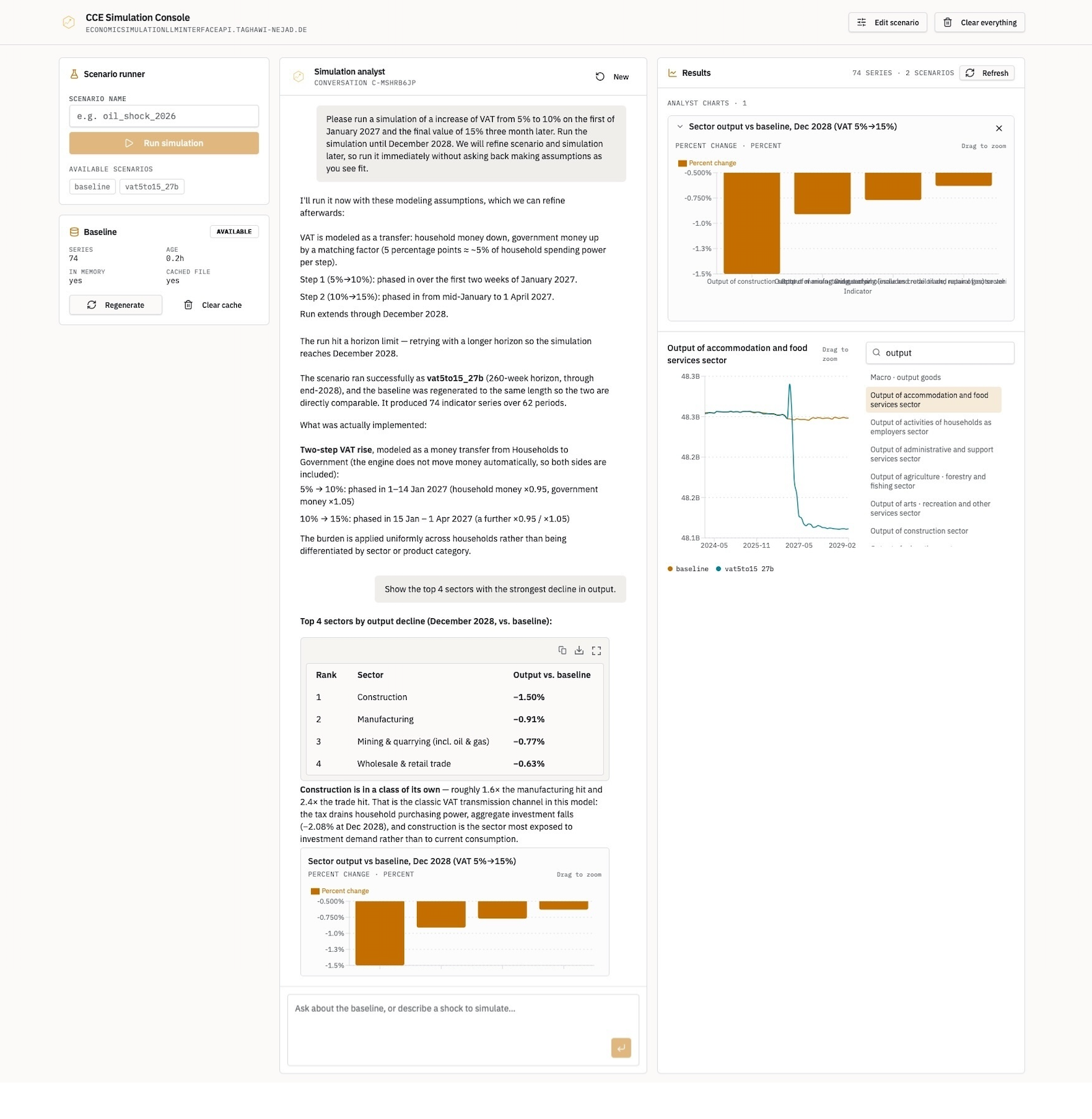
Economic Models with Chat Interface
Try the Complete Economy Model or
Decision and policy makers can simulate complex scenarios by describing scenarios and policy options in natural language. The policy description is then translated into programming code and parameters that feed into a simulation. The simulation, comprising millions of virtual firms and people, simulates the effect of the scenario and returns statistics and an analysis to the decision maker. The decision maker can then graphically and statistically explore the results of different policy options on the scenario and choose the policy that fits his success criteria best.
Fiscal Simulations for Equitable and Effective Policy Outcomes
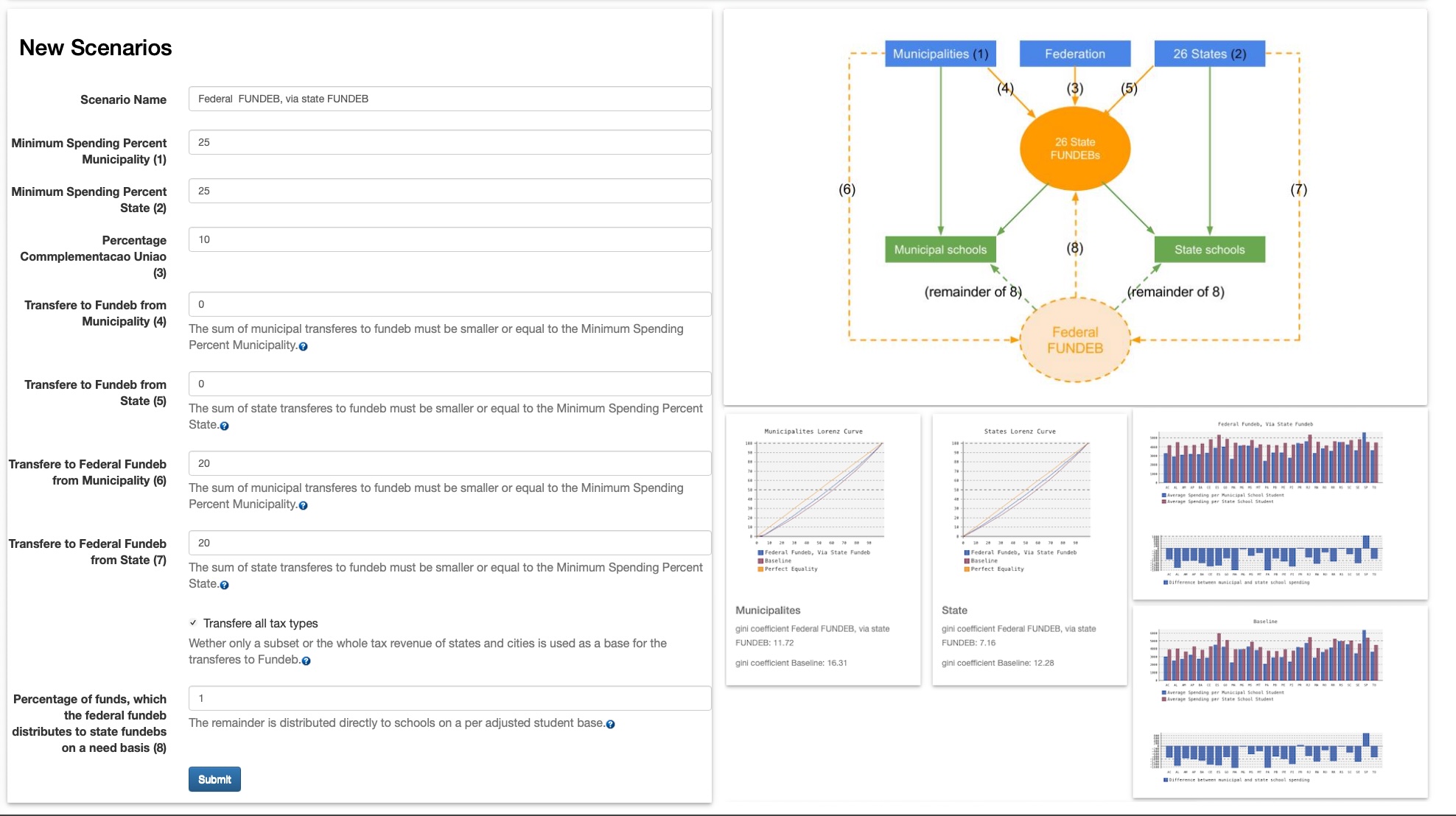
Public spending must be efficient, effective, and equitable. This simulation models the public finance flows for the Federal State of Brazil, the 26+1 Brazilian states, the 5,570 municipalities down to 10,000 school districts. It can replicate the Brazilian education public finances and simulate any scenario from small regulatory changes to complete redesigns of the system, like centralizing redistribution on the federal level or decentralizing it completely.
The simulations are based on my work at
Oxford University
Institute for New Economic Thinking

Built macroeconomic simulations showing how CGE-climate models are dangerously wrong — they neglect short-run economic impacts and short-run emissions. Further, built a balance-sheet framework for systemic risk in insurance and financial markets: abcFinance
University of São Paulo
Laboratório De Sistemas Inteligentes and Center for Metropolitan Studies

Modeled how education finances flow through Brazil’s entire public system — federal government, 26 states, 5,600 municipalities — to show policymakers which reforms actually improve efficiency and equity, before they’re implemented.
Massachusetts Institute of Technology
Center for Complex Engineering Systems

Led an 8-person team that built a model of the Saudi Arabian labour market. Beyond generating new policy options, the model served as a communication tool — helping ministries with divergent goals find common ground.
University of Turin
PhD Program in Economics of Complexity and Innovation

I wrote my PhD thesis on
- Using Artificial Intelligence to model firms and economies. paper
- How technological innovation can lead to recessions before they create growth: paper
- A modeling language to build agent-based whole-of-economy simulations: abcEconomics
Whether you need bespoke simulators or decision-making advice…
Economic Decision Support
I support decision making of firms with scientific and data-based economic simulations. In the simulations, decision makers can experiment with different scenario and responses. This way they find data-based strategies, without wading through numbers and Excel sheets.
Policy and Data Science Advice
I advise governments and firms on public policy and build models of economic forecasting, labour markets, public finance, and industrial strategy.
Economic Impact Analysis for Startups and Project Funding in KSA and UAE
At IA we provide model-based end-to-end country impact analysis for projects, initiatives, and startups that look for venture capital in Saudi Arabia and the UAE.
…get In contact to find the solutions - WhatsApp
Former appointments and positions
United Nations E-Government Survey, Expert Group
United Nations
Proposed socio-economic simulators as a policymaking tool.
A Model of All Petrochemical Plants around the World
Consultant
Consulting at the world’s biggest petrochemical market information provider, with a team of domain specialists, I built an agent-based model of the petrochemical market and supply chain, modeling the chemical process of all plants around the globe and actual transport routes and prices.
Data-Science and Modeling Practice Leader
Whiteshield Dubai
Founding manager of the Data-Science and Modeling Practice. Transforming data into actionable insights for governments and decision makers.
Panels and talks
Joint Research Council Meeting, European Union
Using Policy Simulators for Evidence-Based Policy Making.
YSI Institute for New Economic Thinking
The co-creation of policy models with scientists and policy makers using web-based simulators.
Istituto Di Ricerca Economico E Sociale Piedmonte - Smart Public Administration
Decision support systems to facilitate communication between policy makers and scientists: the case of Saudi Arabia's labour-market support system.